Let a skill organise the session
Skill-led exercise gives attention a different job. Instead of filling a work period or accumulating distance, you try to make a movement more controlled, economical or repeatable. Bouldering and calisthenics provide clear examples: the session revolves around attempts and feedback. This can offer variety to an experienced exerciser without making exhaustion the measure of useful work.
Use a problem rather than a repetition target
Bouldering involves climbing short routes, often called problems, without ropes. Indoor settings use padded landing areas, but falling and landing remain skills that require instruction. The problem asks you to connect holds through body position, foot placement and movement choices rather than merely repeat an exercise.
The International Federation of Sport Climbing distinguishes boulder competition from lead and speed climbing. Competition rules help explain the discipline, but recreational practice need not copy the pressure of a competition attempt. A climber can revisit one move, choose an easier problem or explore a different sequence.
Grades are difficulty indicators, not a complete description of an individual experience. A balance-focused slab and a steep, grip-heavy problem can challenge different strengths. Moving sideways between styles may teach more than treating every session as an attempt to increase a grade.
Make the progression visible
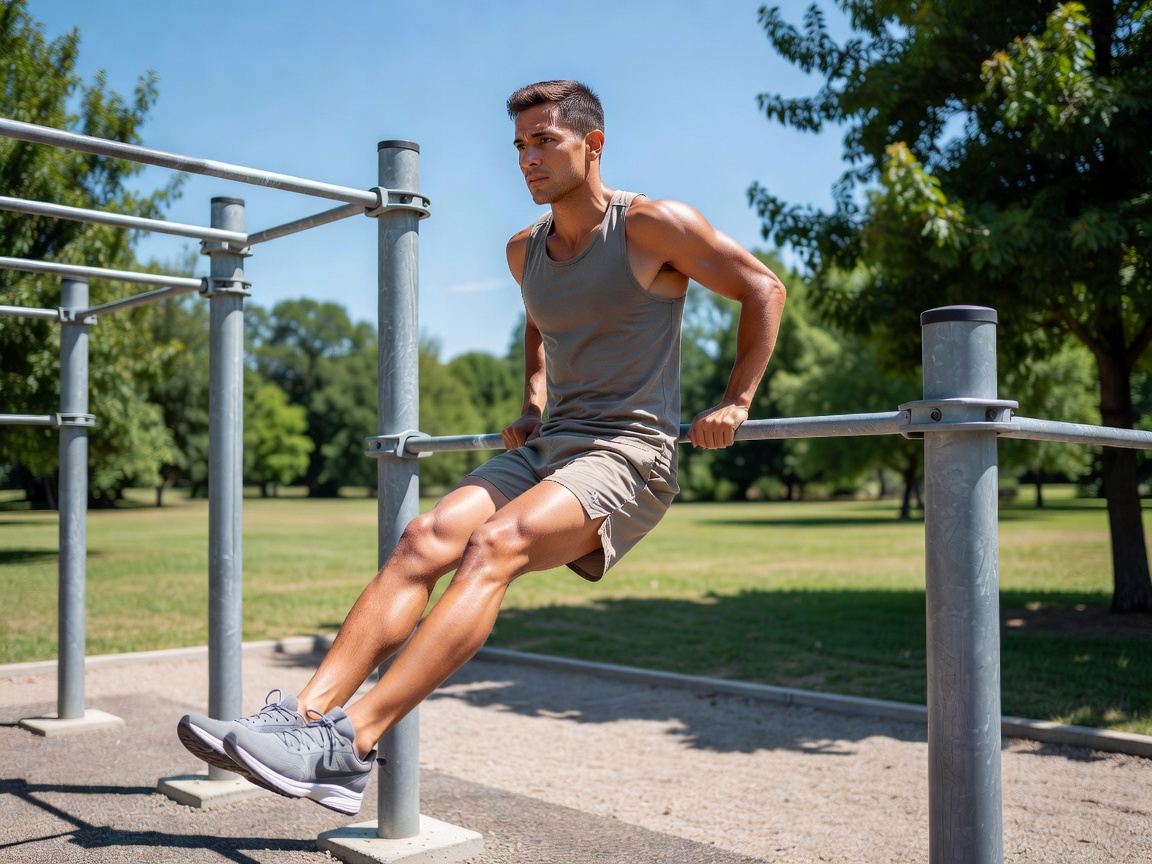
Calisthenics uses bodyweight movements such as push-ups, pull-ups, supports and holds. Changing leverage, assistance, range of motion or body position can make a progression more or less demanding. The important comparison is between versions you can control, not between your current movement and an impressive finished skill.
Gymnastics offers a related but distinct example. Artistic gymnastics uses apparatus-specific skills and routines within a formal sport, with the International Gymnastics Federation providing its rules framework. Borrowing a ring support or handstand drill does not make a recreational session equivalent to gymnastics training.
Outdoor bars can make practice relatively simple to organise, but access alone does not supply coaching or a safe progression. Check the equipment and surface, understand how to exit the movement and resist using unstable improvisations to bridge a skill gap.
Give feedback a specific target
- Attempt
- A purposeful try at a movement or sequence, followed by time to assess what happened.
- Progression
- A related version that changes the demand while preserving the skill you are learning.
- Constraint
- A deliberate limit, such as a foot-placement rule or supported position, that directs attention.
- Quality marker
- A visible feature to compare, such as a controlled landing, stable support or consistent starting position.
Choose one observable detail at a time. In bouldering, that might be placing a foot before shifting weight. In a bodyweight support, it might be maintaining the same shape throughout the hold. “Try harder” gives little information about which change produced a better attempt.
If using video for your own review, respect other participants’ privacy and any venue rules. A qualified instructor’s feedback is especially valuable when a movement has a technical exit or fall risk; a recording cannot provide physical supervision.
Let rest protect the next attempt
Long pauses do not necessarily mean a session lacks structure. They may preserve grip, concentration or coordination for a demanding attempt. Conversely, repeating failures without a clear adjustment can create fatigue without producing useful information. Track the reason for another attempt, not just the count.
Slacklining is another skill-led example: balancing on a tensioned line makes attention, small adjustments and a controlled exit central. It is not interchangeable with climbing or bar work, but it illustrates the same organising principle. Equipment setup and appropriate instruction matter before difficulty.
Measure repeatability rather than spectacle
- Choose a skill and a version suited to your existing experience.
- Identify one quality marker that can be observed without guessing.
- Practise with enough separation to keep attempts meaningful.
- Record what changed: assistance, body position, confidence or consistency.
- Finish when the planned practice loses its purpose, rather than chasing a dramatic final attempt.
A clean repetition at a familiar level can be more informative than an accidental success at a harder one. That does not make skill practice effortless; it changes what counts as progress. Treat these ideas as general session comparisons. For pain, injury concerns or individual suitability, seek a qualified health professional; for technical skills, seek competent instruction in the relevant discipline.